

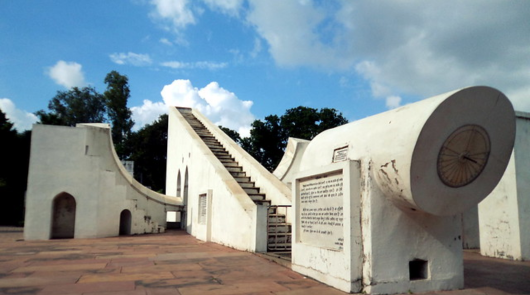
Jantar Mantar, Ujjain – Ancient Observatory of Time and Space
When we think of Ujjain, spirituality and temples often take the spotlight. But this historic city also holds a place of pride in the world of science and astronomy. Standing as a symbol of India’s advanced ancient knowledge is the Jantar Mantar of Ujjain, one of the country’s oldest astronomical observatories.
Built in the 18th century by Maharaja Jai Singh II of Jaipur, Jantar Mantar Ujjain is part of a series of observatories also found in Delhi, Jaipur, Varanasi, and Mathura. What makes the Ujjain observatory particularly special is its location – Ujjain has been considered the prime meridian of India in ancient times, the center for astronomical calculations and timekeeping.
The observatory consists of several large stone instruments, each designed with precision to study the movements of celestial bodies. These instruments were used to measure time, track planets, predict eclipses, and calculate the positions of stars with surprising accuracy. Long before the invention of modern telescopes, Indian astronomers used these devices to deepen their understanding of the universe.
Walking through Jantar Mantar today is like stepping into a classroom of ancient science. The massive structures, though simple in appearance, are highly sophisticated in their function. Instruments like the Samrat Yantra (giant sundial), Nadivalaya Yantra, and Shanku Yantra showcase the brilliance of architectural astronomy, where stone and mathematics merge to decode the mysteries of the cosmos.
For visitors, the experience is both educational and awe-inspiring. Guides at the site often explain how these instruments worked and how Ujjain played a central role in India’s astronomical traditions. It’s fascinating to realize that centuries ago, scholars stood on the very grounds of Jantar Mantar, calculating time and planetary movements with such accuracy.
Apart from its scientific importance, the observatory is also a reminder of India’s rich heritage, where spirituality and science coexisted in harmony. Even today, Ujjain’s connection with timekeeping continues, as the city is considered a reference point for Hindu calendars and astrology.
In short, a visit to Jantar Mantar, Ujjain, is a must for anyone who loves history, science, or culture. It is not just an observatory—it is a timeless monument that reflects the brilliance of India’s ancient knowledge and its deep relationship with the universe.